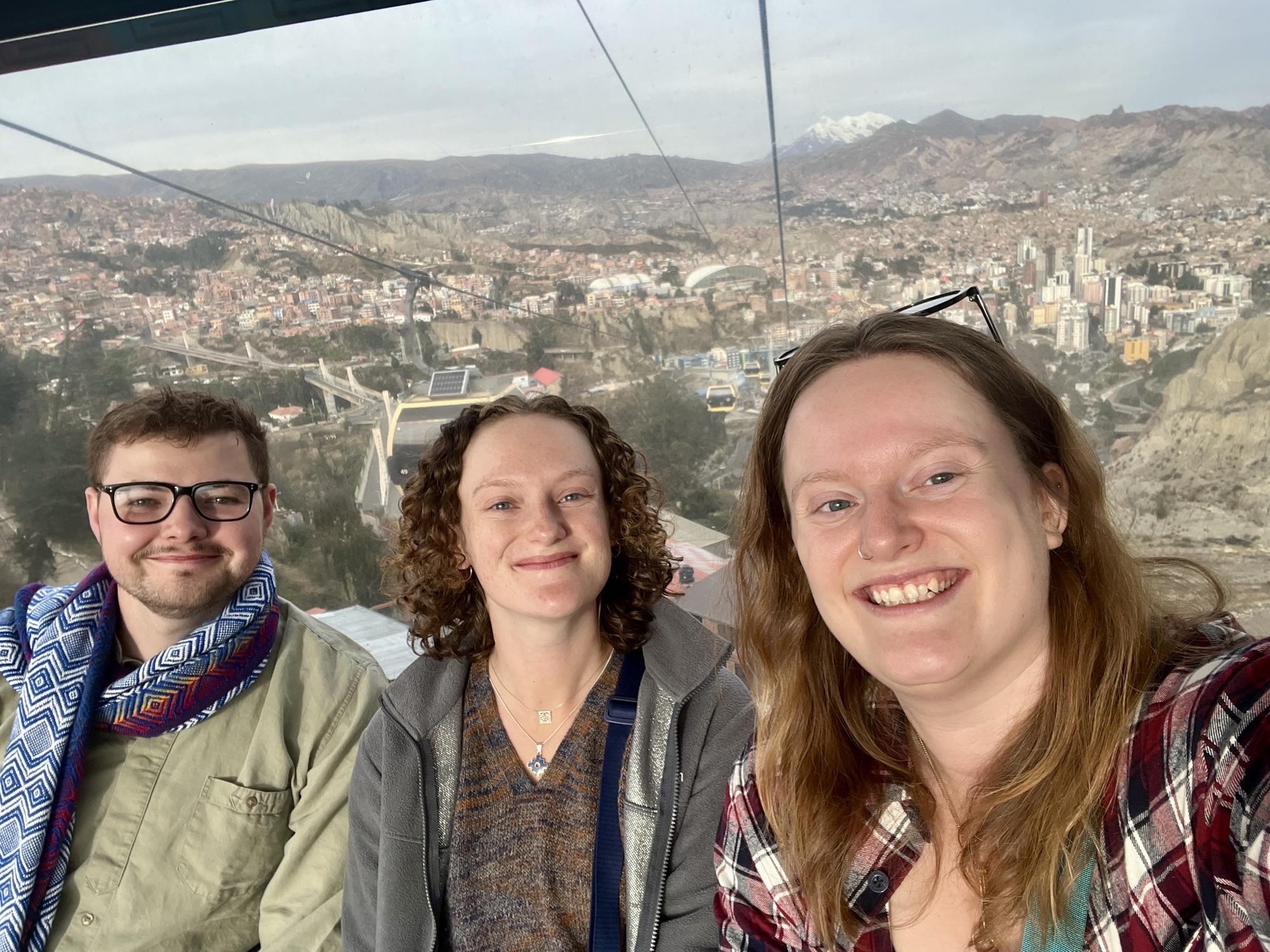
La Paz was the base for our time in Bolivia, with road blockades making travel a bit uncertain, we decided to fly between La Paz and our other destinations, and it is also where we will fly home from, so we’ve spent a good bit of time here! Contrary to what you might think, it’s not the official capital of Bolivia: it is the legislative and executive capital, but Sucre is the judicial and constitutional capital, meaning La Paz can’t claim to be the highest capital city in the world!
It is a crazy city that felt a bit like hard work. We’d been warned already by a French couple: ‘c’est dur’. This is largely because of the hills combined with the altitude, making it a workout to walk basically anywhere. In our case, it was made harder by some illness and an unfortunate pickpocketing!
That being said, we had a great walking tour around the city and learned more about its history and current struggles with the upcoming election. We saw an incredible cemetery, where the maximum tenancy is 5 years due to sheer popularity and lack of space. There is a mass of pigeons in the main square and crazy collections of wires everywhere, as well as some very pretty tourist market streets, if you’re able to ignore the dead baby llamas that are sold in the witches market…
There are 36 different native communities in Bolivia and La Paz is predominantly Aymara, different to the Quechua communities we had become more familiar with in Peru. Winter solstice (21st June) is the Aymara new year and people flock to the ancient ruins of Tiwanaku, which we visited – though not on the 21st!


Weather:
So much warmer than expected! We were prepared for cold because the weather forecast said cold, but it was definitely not cold by British standards.
Where we stayed:
In a couple of very nice apartments, one before my sister Zoë joined and another one for after. Both in the Sopacachi neighbourhood which was slightly out of town and a nice, chill area with a good supermarket.
We also had a brief stint in Onkel’s Inn at the airport between flights, which was tiny and hot and noisy, but did the job.


Best thing we ate:
The star of the show was unsurprisingly a restaurant that is widely recognised as Bolivia’s best: Gustu. It is just out of town in a posher suburb, a fun cable car ride away. We were promised an eight-course tasting menu, made entirely of Bolivian ingredients and boy did it deliver. We each had a slightly different series of dishes (GF, pesci, ‘normal’) and Chris got the drinks pairing to go with. The waiters were all so lovely and gave us descriptions of each dish, where the ingredients came from and even advice on how to eat it for the best experience. And all this for just £28 a head!


On our return journey, we also had some great food at Popular Cocina and Ali Pacha, the latter being a vegan restaurant by a chef who trained at Gustu.


Coolest thing we did:
From the city we did a couple of day trips, one to the Valley of the Moon – not to be confused with the much bigger one in Chile – and Tiwanaku, a large pre-Inca site.
The first was probably my favourite, with the muddy sandstone having eroded into stalagmites that make for an eerie and super cool landscape. Tiwanaku, after having been spoilt for ruins in Cusco, was still impressive, but I fear I might be at my limit with old rocks. The structures here were likely the oldest we’ve seen this trip, many being over 1000 years old.


Bonus:
Getting a cable car around as public transport! La Paz has the largest cable car network in the world (10 lines) which is well-suited to its landscape. Chris was conveniently able to get the Teleferico home from his exciting trip to the police station – reporting the phone pickpocketing he suffered. For once travel insurance will pay off!


From La Paz, we fly to Sucre so follow along as we try to finish our posts before we land in London..!
Besos,
Florence & Chris